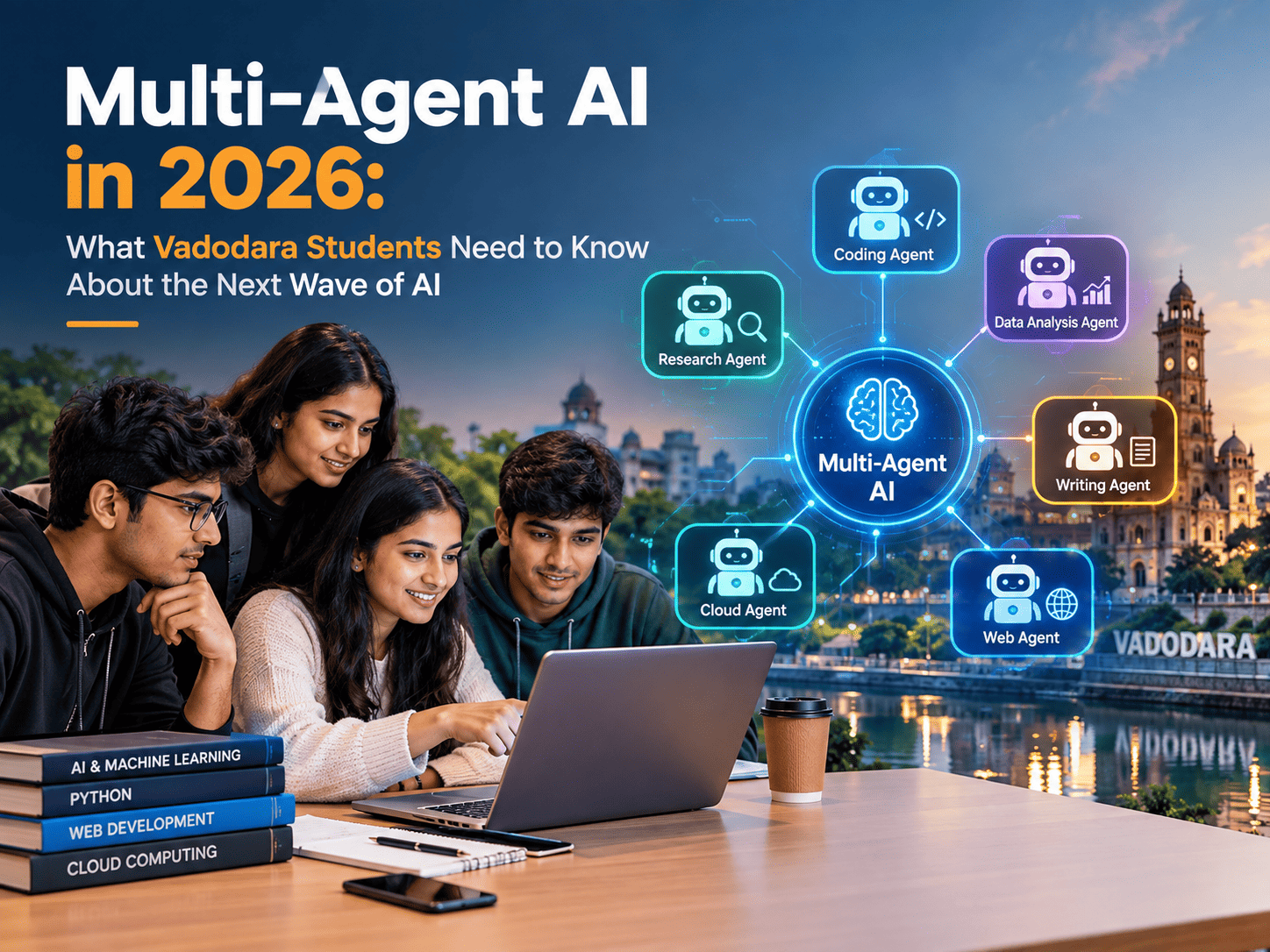
Multi-Agent AI in 2026: What Vadodara Students Need to Know About the Next Wave of AI
Artificial Intelligence • Technology • Career
Artificial Intelligence is moving beyond single chatbots and individual AI tools. In 2026, multi-agent AI systems are creating a new way of solving complex problems by allowing multiple specialized AI agents to work together.
1. Introduction
Artificial Intelligence has changed dramatically in just a few years. Earlier, most people interacted with AI through simple chatbots, recommendation systems, voice assistants and automated software features.
Generative AI introduced another major shift. Instead of simply following predefined instructions, modern AI systems can understand natural language, generate content, analyze information, write code and assist with complex tasks.
But another important development is now gaining attention: Multi-Agent AI.
Instead of asking one AI system to perform every part of a complicated task, multi-agent systems divide the work between multiple specialized AI agents. Each agent can have a different role, responsibility, toolset or objective.
For students in Vadodara who are planning careers in AI, software development, data science, cybersecurity, cloud computing or automation, understanding this shift can help them prepare for the changing technology landscape.
2. What Is Multi-Agent AI?
Multi-Agent AI refers to an AI architecture where multiple autonomous or semi-autonomous AI agents cooperate to accomplish a larger objective.
Each agent can be designed to focus on a particular task. For example, one agent may research information, another may analyze the research, another may write content, and another may verify the final result.
Simple Example
Imagine that a company wants to build an AI-powered market research report.
- Research Agent → Collects relevant information
- Data Agent → Organizes and analyzes data
- Analysis Agent → Identifies important findings
- Writing Agent → Creates the report
- Review Agent → Checks the final output
Instead of one AI trying to perform every task, multiple agents cooperate within a larger workflow.
3. Single AI Agent vs Multi-Agent AI
Understanding the difference between a single AI agent and a multi-agent system is important before learning advanced AI development.
| Feature | Single AI Agent | Multi-Agent AI |
|---|---|---|
| Agents | Usually one | Multiple agents |
| Responsibilities | Broad responsibility | Responsibilities can be divided |
| Coordination | Limited | Central or distributed coordination |
| Specialization | Usually general-purpose | Agents can specialize |
| Complex workflows | Can become difficult to manage | Can divide complex workflows |
4. How Does a Multi-Agent AI System Work?
A multi-agent system normally contains several components that work together. The exact architecture depends on the application, but the workflow commonly includes planning, task assignment, execution, communication and verification.
01. Goal
The system receives a larger objective.
02. Planning
The task is divided into smaller responsibilities.
03. Execution
Specialized agents perform assigned tasks.
04. Review
Results are checked before completion.
Communication between agents is an important part of this architecture. Agents may exchange information, pass outputs to another agent or request additional work.
5. Common Roles Inside a Multi-Agent System
There is no universal list of agents that every system must contain. Developers choose agent roles based on the problem they are solving.
Planner Agent
Breaks a large objective into smaller tasks and determines an execution strategy.
Research Agent
Searches, collects and organizes relevant information.
Coding Agent
Helps implement software features, scripts or automation workflows.
Data Agent
Processes datasets, performs analysis and prepares information.
Testing Agent
Tests outputs and identifies possible errors or inconsistencies.
Reviewer Agent
Reviews results and determines whether additional work is required.
6. A Real-World Example of Multi-Agent AI
Consider an e-commerce company that wants to automatically analyze customer feedback and identify business opportunities.
Possible Multi-Agent Workflow
- Collection Agent: gathers customer feedback.
- Classification Agent: identifies categories such as product quality, delivery or customer service.
- Sentiment Agent: analyzes positive, negative or neutral sentiment.
- Insight Agent: identifies recurring customer concerns.
- Recommendation Agent: creates possible actions.
- Review Agent: checks the final recommendations.
This example shows why multi-agent architecture can be useful when a problem naturally contains several different types of work.
7. Multi-Agent AI and Generative AI
Generative AI provides many of the capabilities that agents use to understand instructions, reason about tasks, generate content and interact with tools.
A multi-agent system can use generative AI models as the intelligence layer behind different specialized agents.
Think of the Architecture Like a Team
Instead of thinking about AI as one assistant, imagine a digital team:
Manager Agent → Specialist Agents → Tools → Results → Review
8. Multi-Agent AI vs Traditional Automation
Traditional automation usually follows predefined rules and workflows. Multi-agent systems can use AI reasoning and dynamic task handling to determine how different tasks should be approached.
| Traditional Automation | Multi-Agent AI |
|---|---|
| Usually rule-based | Can use AI-driven reasoning |
| Fixed workflows | Can adapt workflow execution |
| Limited specialization | Specialized agents can be created |
| Predictable sequence | Can involve dynamic coordination |
9. Multi-Agent AI in Software Development
Software development is one of the areas where multi-agent systems can potentially create sophisticated workflows.
Different agents can work on different stages of development while a coordinating system manages the overall workflow.
10. Multi-Agent AI in Data Science
Data science workflows often contain multiple stages, including data collection, cleaning, analysis, visualization and interpretation.
Agents can potentially specialize in these different stages.
- Data collection
- Data cleaning
- Exploratory analysis
- Model experimentation
- Visualization
- Report generation
- Result verification
11. Multi-Agent AI in Cybersecurity
Cybersecurity is another area where large amounts of information must be monitored, analyzed and prioritized.
AI agents can be designed for defensive tasks such as log analysis, alert classification, threat intelligence processing and security reporting.
Security-sensitive AI systems require strong access controls, monitoring, human oversight and careful testing. AI output should not automatically be treated as a trustworthy security decision.
12. How Businesses Can Use Multi-Agent AI
Multi-agent systems can be designed for many business workflows. The value depends on whether the workflow genuinely benefits from task specialization and coordination.
Customer Support
Different agents can classify, retrieve information and prepare responses.
Marketing
Research, content planning, analysis and reporting can be divided.
Finance
Agents can assist with data preparation, analysis and reporting.
Operations
Multiple workflow steps can be coordinated through specialized agents.
13. Technologies Behind Multi-Agent AI
Multi-agent AI is not one single technology. It is usually built by combining AI models, programming languages, APIs, databases, orchestration frameworks, tools and application infrastructure.
| Technology Area | Examples |
|---|---|
| Programming | Python, JavaScript, TypeScript |
| AI Models | Large language models and other AI models |
| Orchestration | Agent workflows and coordination frameworks |
| Data | SQL databases, vector databases and data stores |
| Infrastructure | Cloud platforms, containers and APIs |
14. Why Python Is Important for Multi-Agent AI
Python has become an important language across AI, machine learning, data science and automation.
Its ecosystem makes it practical for students and developers who want to experiment with AI applications, APIs, data processing and agent workflows.
Python Skills Worth Learning
- Python fundamentals
- Object-oriented programming
- APIs and HTTP
- JSON and data handling
- Databases
- Machine learning basics
- AI application development
15. Why Vadodara Students Should Pay Attention to Multi-Agent AI
Students in Vadodara are entering a technology environment where traditional programming skills increasingly connect with AI, cloud computing, automation, cybersecurity and data.
Learning about multi-agent AI does not mean that every student needs to immediately become an AI researcher. The more practical goal is to understand how AI systems are being integrated into software and business workflows.
Start with programming fundamentals, then build knowledge in APIs, databases, AI concepts, automation and practical projects.
16. Multi-Agent AI Learning Roadmap for Students
Students should avoid trying to learn every AI framework at once. A structured roadmap provides a stronger foundation.
Step 1 — Learn Programming
Learn Python or another programming language and understand variables, functions, loops, data structures and object-oriented programming.
Step 2 — Learn APIs
Understand HTTP requests, REST APIs, JSON, authentication and API integration.
Step 3 — Understand AI
Learn basic concepts such as machine learning, generative AI, language models, embeddings and AI application architecture.
Step 4 — Build AI Applications
Create applications that connect AI models with software, databases and external tools.
Step 5 — Learn Agents
Understand tool use, planning, memory, task execution and agent workflows.
Step 6 — Build Multi-Agent Projects
Combine multiple specialized agents into a practical workflow.
17. Multi-Agent AI Project Ideas for Students
Practical projects are one of the best ways to understand how agents communicate and cooperate.
AI Research Team
Build research, summarization and review agents that work together.
AI Coding Team
Create planning, coding and testing agents for a small software project.
Student Helpdesk
Build agents for FAQs, document retrieval and response preparation.
Resume Analyzer
Use separate agents for resume parsing, skill analysis and feedback.
Marketing Assistant
Combine research, content planning and analytics agents.
Data Analysis Team
Create agents for data cleaning, analysis and report generation.
18. Understanding Agentic Workflows
An agentic workflow describes a system where AI can perform multiple steps toward a goal instead of producing only one isolated response.
Goal → Plan → Execute → Observe → Adjust → Verify → Complete
Multi-agent systems extend this idea by allowing different agents to participate in different stages of the workflow.
19. Why Human Oversight Still Matters
Multi-agent systems can automate complex workflows, but automation does not remove the need for human judgment.
AI agents can make incorrect assumptions, misunderstand requirements, produce inaccurate information or make unsuitable decisions.
Humans should remain responsible for important decisions, especially where accuracy, security, privacy, safety or business impact matters.
20. Challenges and Risks of Multi-Agent AI
Multi-agent architecture can introduce new engineering challenges. More agents do not automatically mean better results.
- Complexity: More agents can make systems harder to design and maintain.
- Incorrect outputs: Individual agents can produce inaccurate information.
- Communication problems: Agents may pass incomplete or incorrect information.
- Security: Tool access and permissions must be carefully controlled.
- Cost: Multiple model calls can increase infrastructure and API usage.
- Debugging: Finding the source of a failure can be more difficult.
21. Skills Students Need for the Multi-Agent AI Era
Students do not need to learn everything at once. Building strong fundamentals first makes advanced AI technologies easier to understand.
| Skill | Why It Matters |
|---|---|
| Programming | Build and customize AI applications |
| Python | Useful across AI, automation and data |
| APIs | Connect AI systems with applications |
| Databases | Store and retrieve application information |
| AI Fundamentals | Understand how AI systems work |
| Problem Solving | Design useful agent workflows |
| Security | Control access, data and tools |
22. Career Opportunities in the Multi-Agent AI Era
Multi-agent AI is not necessarily a separate career category by itself. Instead, it is becoming an additional skill area across several technology roles.
Builds AI-powered software applications.
Works with machine learning systems and models.
Creates AI-powered business workflows.
Connects AI capabilities with complete web applications.
Uses data, statistics and AI to generate insights.
Designs AI solutions around specific business requirements.
23. Will Multi-Agent AI Replace Developers?
AI can automate portions of software development and other knowledge-work workflows, but that does not mean every development responsibility can be delegated safely or effectively.
Developers still need to understand requirements, architecture, security, performance, testing, maintainability and business context.
The important skill is not competing with AI at repetitive tasks. It is learning how to use AI effectively while understanding the technology underneath.
24. Common Mistakes Students Should Avoid
-
Learning tools without fundamentals
Understanding programming and software concepts should come first. -
Using too many frameworks
Learn concepts before collecting a large number of tools. -
Trusting AI blindly
AI-generated code and information must be reviewed. -
Ignoring security
AI agents that access tools or data need carefully designed permissions. -
Building demos without understanding the architecture
Students should understand how the components communicate.
25. A Practical Learning Plan for 2026
26. The Future of Multi-Agent AI
Multi-agent AI is part of a broader movement toward software systems that can plan, use tools, perform tasks and adapt workflows with less manual intervention.
Future systems may combine AI agents with business applications, databases, cloud infrastructure, robotics, cybersecurity systems and enterprise software.
At the same time, reliability, security, cost control, observability and human oversight will remain important engineering challenges.
Students who understand both software fundamentals and AI-driven workflows can build a stronger foundation for adapting to future tools.
27. Frequently Asked Questions
28. Start Building Your AI Skills with TCIIT
The next generation of technology will combine programming, artificial intelligence, automation, cloud computing and data-driven applications.
For students in Vadodara, building a strong foundation in programming and then progressing toward AI, machine learning, automation and AI agents can provide a practical path for exploring modern technology.
At TCIIT, students can explore programming, AI, machine learning, data science and modern technology skills through practical, project-oriented learning.
29. Conclusion
Multi-Agent AI represents an important direction in the evolution of artificial intelligence. Instead of relying on a single AI system for every task, organizations can design workflows where multiple specialized agents cooperate to solve complex problems.
For students, the important lesson is not to chase every new AI tool. Strong programming fundamentals, problem-solving ability, APIs, databases, AI concepts and practical project experience remain valuable foundations.
Students who understand how AI works and how software systems are built can then learn how to integrate AI agents into real applications and workflows.
For students in Vadodara, 2026 is a useful time to start exploring this technology through practical learning rather than simply watching AI trends.
Learn the fundamentals, experiment with AI, build real projects and develop the ability to work with intelligent systems.