AWS Certified Data Engineer - Associate (DEA-C01) Course

The AWS Certified Data Engineer – Associate (DEA-C01) course is designed for professionals who want to build, automate, and optimize data pipelines on the AWS cloud platform. This course covers essential AWS data services such as Amazon S3, Glue, Redshift, Kinesis, and Athena, focusing on data ingestion, transformation, storage, and analysis. Learners will gain hands-on experience in designing scalable and secure data architectures, implementing ETL workflows, and ensuring data quality and governance. Ideal for data engineers, analysts, and cloud professionals, this course prepares you to earn the DEA-C01 certification and excel in managing data-driven solutions on AWS.
thumb

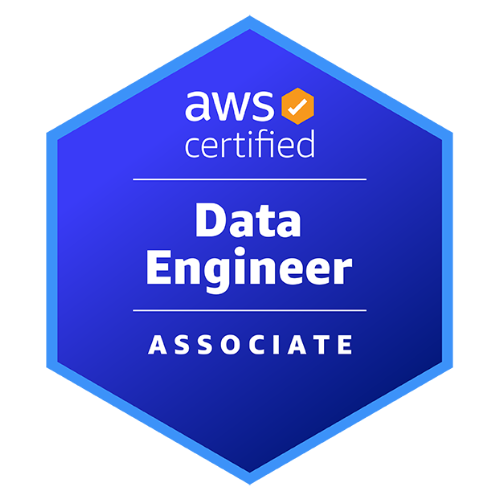
AWS Certified Data Engineer – Associate (DEA-C01) Training Course

This course provides comprehensive training in data engineering on AWS, covering topics such as data ingestion, transformation, storage, and analysis. Learners will gain practical experience with AWS services like S3, Glue, Redshift, and Kinesis, preparing them for the DEA-C01 certification exam.

  • Data Ingestion and Transformation
  • Data Store Management
  • Data Operations and Support
  • Data Security and Governance

Enroll today to gain expertise in AWS data engineering and advance your career with the AWS Certified Data Engineer – Associate certification!

What will I learn?

  • Design and implement data pipelines using AWS services.
  • Manage and optimize data storage solutions.
  • Ensure data quality and implement security measures.
  • Prepare for the AWS Certified Data Engineer – Associate exam.

Requirements

  • Basic understanding of cloud computing concepts.
  • Familiarity with AWS services is beneficial but not mandatory.
  • Willingness to engage in hands-on labs and projects.

AWS Certified Data Engineer - Associate (DEA-C01) Course Content

Data Ingestion and Transformation
Perform data ingestion
  • Throughput and latency characteristics for AWS services that ingest data
  • Data ingestion patterns (for example, frequency and data history)
  • Streaming data ingestion
  • Batch data ingestion (for example, scheduled ingestion, eventdriven ingestion)
  • Replayability of data ingestion pipelines
  • Stateful and stateless data transactions
Transform and process data
  • Creation of ETL pipelines based on business requirements
  • Volume, velocity, and variety of data (for example, structured data, unstructured data)
  • Cloud computing and distributed computing
  • How to use Apache Spark to process data
  • Intermediate data staging locations
Orchestrate data pipelines
  • How to integrate various AWS services to create ETL pipelines
  • Event-driven architecture
  • How to configure AWS services for data pipelines based on schedules or dependencies
  • Serverless workflows
Apply programming concepts
  • Continuous integration and continuous delivery (CI/CD) (implementation, testing, and deployment of data pipelines)
  • SQL queries (for data source queries and data transformations)
  • Infrastructure as code (IaC) for repeatable deployments (for example, AWS Cloud Development Kit [AWS CDK], AWS CloudFormation)
  • Distributed computing
  • Data structures and algorithms (for example, graph data structures and tree data structures)
  • SQL query optimization
Data Store Management
Choose a data store
  • Storage platforms and their characteristics
  • Storage services and configurations for specific performance demands
  • Data storage formats (for example, .csv, .txt, Parquet)
  • How to align data storage with data migration requirements
  • How to determine the appropriate storage solution for specific access patterns
  • How to manage locks to prevent access to data (for example, Amazon Redshift, Amazon RDS)
Understand data cataloging systems
  • How to create a data catalog
  • Data classification based on requirements
  • Components of metadata and data catalogs
Manage the lifecycle of data
  • Appropriate storage solutions to address hot and cold data requirements
  • How to optimize the cost of storage based on the data lifecycle
  • How to delete data to meet business and legal requirements
  • Data retention policies and archiving strategies
  • How to protect data with appropriate resiliency and availability
Design data models and schema evolution
  • Data modeling concepts
  • How to ensure accuracy and trustworthiness of data by using data lineage
  • Best practices for indexing, partitioning strategies, compression, and other data optimization techniques
  • How to model structured, semi-structured, and unstructured data
  • Schema evolution techniques
Data Operations and Support
Automate data processing by using AWS services
  • How to maintain and troubleshoot data processing for repeatable business outcomes.
  • API calls for data processing
  • Which services accept scripting (for example, Amazon EMR, Amazon Redshift, AWS Glue)
Analyze data by using AWS services
  • Tradeoffs between provisioned services and serverless services
  • SQL queries (for example, SELECT statements with multiple qualifiers or JOIN clauses)
  • How to visualize data for analysis
  • When and how to apply cleansing techniques
  • Data aggregation, rolling average, grouping, and pivoting
Maintain and monitor data pipelines
  • How to log application data
  • Best practices for performance tuning
  • How to log access to AWS services
  • Amazon Macie, AWS CloudTrail, and Amazon CloudWatch
Ensure data quality
  • Data sampling techniques
  • How to implement data skew mechanisms
  • Data validation (data completeness, consistency, accuracy, and integrity)
  • Data profiling
Data Security and Governance
Apply authentication mechanisms
  • Principle of least privilege as it applies to AWS security
  • Authorization methods (role-based, policy-based, tag-based, and attributebased)
  • Role-based access control and expected access patterns
  • Methods to protect data from unauthorized access across services
  • VPC security networking concepts
  • Differences between managed services and unmanaged services
  • Authentication methods (password-based, certificate-based, and role-based)
  • Differences between AWS managed policies and customer managed policies
Ensure data encryption and masking
  • Data encryption options available in AWS analytics services (for example, Amazon Redshift, Amazon EMR, AWS Glue)
  • Differences between client-side encryption and server-side encryption
  • Protection of sensitive data
  • Data anonymization, masking, and key salting
Prepare logs for audit
  • How to log application data
  • How to log access to AWS services
  • Centralized AWS logs
Understand data privacy and governance
  • How to protect personally identifiable information (PII)
  • Data sovereignty

Start Your Enrollment

We are variations of passages the have suffered.

Why Choose Us ?

Our AWS Certified Data Engineer – Associate (DEA-C01) course is designed by industry experts to provide hands-on experience in building and managing data pipelines on AWS. With real-world projects, interactive labs, and globally recognized certification, we ensure you gain the skills to excel in data engineering roles. Flexible learning options, career guidance, and placement support help you succeed in the growing field of cloud data engineering.

Career Opportunities After AWS Certified Data Engineer – Associate (DEA-C01) Course

The AWS Certified Data Engineer – Associate (DEA-C01) course equips learners with the skills to design, implement, and manage data pipelines on AWS. Graduates can pursue roles such as Data Engineer, Data Architect, Cloud Data Engineer, ETL Developer, and Business Intelligence Engineer, focusing on data ingestion, transformation, storage, and analysis using AWS services.

AWS Certified Data Engineer – Associate (DEA-C01) Certification

Validate Your Expertise in AWS Data Engineering

  • Complete modules on data ingestion, transformation, and storage using AWS services.
  • Engage in hands-on labs and projects to reinforce learning.
  • Pass the AWS Certified Data Engineer – Associate (DEA-C01) exam to earn the official credential.

Upon successful completion of the course, learners receive the AWS Certified Data Engineer – Associate certification through our Learning Management System (LMS). This certification demonstrates proficiency in building and managing data pipelines, ensuring data quality, and implementing security measures on AWS.

thumb
whatsapp