Machine Learning Course

Our Machine Learning Course is designed to build strong knowledge and practical skills in developing intelligent, data-driven systems. You’ll learn core ML concepts including supervised and unsupervised learning, model training, evaluation, feature engineering, and optimization. The course covers popular algorithms such as regression, classification, clustering, decision trees, SVM, and more. With hands-on projects, real-world datasets, and Python-based tools, you’ll gain practical experience in building, testing, and deploying machine learning models used across modern industries.

thumb

Machine Learning Certification Training Course

Our Machine Learning Course is designed to help learners master the art and science of building predictive models using real-world data. This course covers the complete ML workflow, including data preprocessing, feature engineering, supervised and unsupervised algorithms, model evaluation, optimization techniques, and deployment of machine learning models. Whether you're a student, IT professional, analyst, engineer, or someone planning to transition into the world of artificial intelligence, this course provides hands-on experience using popular tools and industry datasets. You will learn how companies like Google, Amazon, Netflix, and Uber use ML algorithms to build intelligent systems.

  • Introduction to Machine Learning & AI
  • Python for Machine Learning (NumPy, Pandas, Matplotlib)
  • Understanding datasets: structure, types & exploration
  • Data preprocessing (cleaning, scaling, encoding, transformations)
  • Exploratory Data Analysis (EDA)

Machine Learning powers the most advanced technologies today—from recommendation engines and fraud detection systems to autonomous vehicles and smart predictions. This course teaches you how to implement ML algorithms using Python, Scikit-Learn, Pandas, NumPy, Matplotlib, and other essential libraries. You will work on real-world ML projects such as churn prediction, house price forecasting, image classification, clustering, anomaly detection, and sales prediction. By the end of this course, you will have the technical ability to build your own machine learning pipelines, tune models, interpret results, and deploy them professionally Enroll today and become a Certified Machine Learning Engineer with hands-on experience in building intelligent predictive models!

What will I learn?

  • Ability to apply machine learning algorithms to solve business problems
  • Skills to preprocess, transform, and analyze complex datasets
  • Strong understanding of classification, regression & clustering models
  • Experience with model optimization and evaluation techniques
  • Ability to build end-to-end ML pipelines using Python
  • Hands-on practice with real-world ML projects & datasets

Requirements

  • Basic understanding of computers
  • Knowledge of Python programming (recommended but not mandatory)
  • Laptop/PC capable of running Python, Scikit-Learn & Jupyter Notebook
  • No advanced math required — concepts explained in simple terms

Machine Learning Course Content

Python Programming

Python Basic Building
  • Python Keywords and identifiers
  • Comments, indentation, statements
  • Variables and data types in Python
  • Standard Input and Output
Operators
  • Control flow: if else elif
  • Control flow: while loop
  • Control flow: for loop
  • Control flow: break & continue
  • Python Data Structures
Strings
  • Lists, Lists comprehension
  • Tuples, Sets
  • Dictionary, Dictionary Comprehension
Python Functions
  • Python Builtin Functions.
  • Python Userdefined Functions.
  • Python Recursion Functions.
  • Python Lambda Functions.
  • Python Exception Handling,
  • Logging And Debugging
Exception Handling
  • Custom Exception Handling
  • Logging With Python
  • Debugging With Python
  • Python OOPS
  • Python Objects And Classes
  • Python Constructors
  • Python Inheritance
  • Abstraction In Python
  • Polymorphism in Python
  • Encapsulation in Python
File Handling
  • Create
  • Read
  • Read
  • Append

Advance Python Programming

Introduction to NumPy
  • NumPy Array
  • Creating NumPy Array
  • Array Attributes,
  • Array Methods
  • Array Indexing,
  • Slicing Arrays
  • Array Operation
  • Iteration through Arrays
Introduction to Pandas
  • Pandas Series
  • Creating Pandas Series
  • Accessing Series Elements
  • Filtering a Series
  • Arithmetic Operations
  • Series Ranking and Sorting
  • Checking Null Values
  • Concatenate a Series
Data Frame Manipulation
  • Pandas Dataframe
  • Introduction Dataframe Creation
  • Reading Data from Various Files
  • Understanding Data
  • Accessing Data Frame Elements using Indexing
  • Dataframe Sorting
  • Ranking in Dataframe
  • Dataframe Concatenation
  • Dataframe Joins
  • Dataframe Merge
  • Reshaping Dataframe
  • Pivot Tables,
  • Cross Tables
  • Dataframe Operations
  • Checking Duplicates
  • Dropping Rows and Columns
  • Replacing Values
  • Grouping Dataframe
  • Plot Styles & Settings
  • Line Plot,
  • Multiline Plot
  • Matplotlib Subplots
  • Histogram, Boxplot
  • Pie Chart ,Scatter Plot
  • Visualization using Seaborn
  • Strip Plot ,Distribution Plot
  • Joint Plot,
  • Violin Plot,
  • Swarm Plot
  • Pair Plot,
  • Count Plot
  • Heatmap
  • Visualization using Plotly
  • Boxplot
  • Bubble Chart
  • Violin Plot
  • 3D Visualization
EDA and Feature Engineering
  • Introduction of EDA
  • Dataframe Analysis using Groupby
  • Advanced Data Explorations

Relational Database (SQL)

Working with SQL Using MySQL
  • Work Bench / SQL Server
  • USE, DESCRIBE,
  • SHOW TABLES
  • SELECT, INSERT
  • UPDATE & DELETE
  • CREATE TABLE
  • ALTER: ADD, MODIFY, DROP
  • DROP TABLE, TRUNCATE, DELETE
  • LIMIT, OFFSET
  • ORDER BY
  • DISTINCT
  • WHERE Clause
  • HAVING Clause
  • Logical Operators
  • Aggregate Functions: COUNT, MIN, MAX, AVG, SUM
  • GROUP BY
  • SQL Primary And Foreign Key
  • Join and Natural Join
  • Inner, Left, Right and Outer joins
Advance SQL
  • Subqueries/Nested Queries/Inner Queries
  • SQL Function And Stored Procedures
  • SQL Window Function
  • CTE In SQL
  • Normalization In SQL

Mathematics

Basic Math
  • Linear Algebra
  • Probability
  • Calculus
  • Develop a comprehensive understanding of coordinate geometry and linear algebra
  • Build a strong foundation in calculus, including limits, derivatives, and integrals

Basic & Advance Statistic

Descriptive Statistics
  • Sampling Techniques
  • Measure of Central Tendency
  • Measure of Dispersion
  • Skewness and Kurtosis
  • Random Variables
  • Bassells Correction Method
  • Percentiles and Quartiles
  • Five Number Summary
  • Gaussian Distribution
  • Lognormal Distribution
  • Binomial Distribution
  • Bernoulli Distribution
Inferential Statistics
  • Standard Normal Distribution
  • ZTest
  • TTest
  • ChiSquare Test
  • ANOVA / FTest
  • Introduction to Hypothesis Testing
  • Null Hypothesis
  • Alternet Hypothesis
Probability Theory
  • What is Probability?
  • Events and Types of Events
  • Sets in Probability
  • Probability Basics using Python
  • Conditional Probability
  • Expectation and Variance

Machine Learning

Introduction to Machine Learning
  • Machine Learning Modelling Flow
  • Supervised and Unsupervised
  • Types of Machine Learning Algorithms
Linear Regression using OLS
  • Introduction of Linear Regression
  • Types of Linear Regression
  • OLS Model
  • Math behind Linear Regression
  • Decomposition Variability
  • Metrics to Evaluate Model
  • Feature Scaling
  • Regularisation Techniques
  • Ridge Regression
  • Lasso Regression
  • ElastivNet Regression
Optimisation Techniques
  • What is Optimisation?
  • Gradient Descent
  • Adagrad Algorithm
  • Adam Algorithm
  • Linear Regression with SGD
  • Prerequisite
Introduction to Stochastic Gradient Descent (SGD)
  • Preparation for SGD
  • Workflow of SGD
  • Implementation of SGD on Linear Regression
  • Preparation for SGD
  • Workflow of SGD
  • Implementation of SGD on Linear Regression
Logistic Regression
  • Maximum Likelihood Estimation
  • Activation Function
  • Performance Metrics
  • Confusion Matrix
  • Precision, Recall, F1Score
  • Receiver Operating Characteristic Curve
KNN
  • Euclidean Distance
  • Manhattan Distance
  • Implementation for KNN
SVM
  • Support Vector Regression
  • Support Vector Classification
  • Polynomial Kernel
  • Cost Function
  • GridSerchCV
Decision Trees
  • Decision Tree for Classification
  • Decision Tree for Regression
  • ID3 Algorithm
  • CART Algorith
  • Entropy
  • Gini Index
  • Information Gain
  • Decision Tree: Regression
  • Mean Square Error
  • PrePruning and PostPruning
Naive Bayes
  • Introduction to Bayes Theorem
  • Explanation for naive bayes
Ensemble Technique
  • Bagging
  • Random Forest Classifier
  • Random Forest Regression
  • Random Forest – Why & How?
  • Feature Importance
  • Advantages & Disadvantages
Boosting
  • Bootstrap Aggregating
  • AdaBoost
  • XgBoost
  • Project For Random Forest
  • Project Penguin Classification
  • Project Texi Prediction
Kmeans Clustering
  • Prerequisites
  • Cluster Analysis
  • Kmeans
  • Implementation of Kmeans
  • Pros and Cons of Kmeans
  • Application of Kmeans
  • Elbow Method
  • Model building for Kmeans Clustering
Hierarchical Clustering
  • Types of Hierarchical Clustering
  • Dendrogram
  • Pros and Cons of Hierarchical Clustering
  • Model building for Hierarchical Clustering
DBSCAN Clustering
  • Introduction for DBSCAN Clustering
  • implementation of DBSCAN
Principal Components Analysis
  • Prerequisites
  • Introduction to PCA
  • Principal Component
  • Implementation of PCA
  • Case study
  • Applications of PCA
  • Project on PCA
Time Series Modelling
  • Understand Time Series Data
  • Visualising Time Series Components
  • Exponential Smoothing
  • ARIMA
  • SARIMA
  • SARIMAX
  • Project on Forecasting
  • Cloud Basics
  • ML on Cloud

Advance MLOps

Introduction of MLOps
  • What and why MLOps
  • MLOps fundamentals
  • MLOps vs DevOps
  • Why DevOps is not sufficient for MLOps
  • Challenges in traditional ML Pipeline
  • DevOps and MLOps tools and platform
  • What is SDLC?
  • Types of SDLC
  • Waterfall vs AGILE vs DevOps vs MLOps
MLOps Foundation
  • Fundamental of Linux for MLOps and data scientist
  • Important Linux Commands
  • Source code managements using GIT
  • GIT configuration and GIT commands
  • YAML for Configuration Writing
  • YAML vs JSON Schema
  • Docker for Containers
  • Docker Basic Command, Dockerhub, Dockerfile
  • Cloud Computing and Cloud Infrastructure
  • Cloud Service Provider- AWS, GCP, AZURE
  • Data Managements and Versioning with DVC
  • Monitoring, Alerting, Retraining With Grafana and prometheus
  • Experiment tracking with MLFLOW
  • Model Serving With BENTOML
End to End project implementation with Deployment implementation with Deployment
  • Understanding Machine learning Workflow and Project Setup
  • Project Template Setup with GitHub
  • Modular workflow Introduction and Implementation
  • Understanding the Training Pipeline and Its Components
  • Data Ingestion, Data Transformation Model Trainer Model
  • Evaluation
  • Creating Prediction Pipeline and End Point Creation
  • Continues Integration, Continues Delivery and Continues
  • Training understanding and Project Deployment
Prompt Engineering
  • Why Prompt Engineering?
  • ChatGPT
  • Few Standard Definitions:
  • Label
  • Logic
  • Model Parameters (LLM Parameters)
  • Basic Prompts and Prompt Formatting
  • Elements of a Prompt:
  • Context
  • Task Specification
  • Constraints
  • General Tips for Designing Prompts
  • Be Specific
  • Keep it Concise
  • Be Contextually Aware
  • Test and Iterate
  • Prompt Engineering Use Cases
  • Information Extraction
  • Text Summarization
  • Question Answering
  • Code Generation
  • Text Classification
  • Prompt Engineering Techniques
  • N-shot Prompting
  • Zero-shot Prompting
  • Chain-of-Thought (CoT) Prompting
  • Generated Knowledge Prompting

Start Your Enrollment

We are variations of passages the have suffered.

Why Choose Us ?

At TCIIT, our Machine Learning Course is designed to build strong skills in data preprocessing, model building, evaluation, optimization, and real-world ML applications. You learn how to train intelligent models using powerful techniques such as regression, classification, clustering, ensemble methods, dimensionality reduction, and more. The training is fully practical, enabling you to work confidently with real datasets and industry-standard tools. Our expert trainers guide you through every step—from basic concepts to advanced ML algorithms—preparing you for careers in Data Science, ML Engineering, AI Development, and Analytics.

Diverse Career Opportunities in Machine Learning: Exploring High-Impact Roles in India’s Artificial Intelligence Landscape

In India, expertise in Machine Learning opens the door to some of the most exciting and rapidly growing career paths within the AI and technology sectors. ML professionals are in high demand across leading global organizations such as Google, Amazon, Meta, Microsoft, IBM, Tesla, and Deloitte, where machine learning forms the backbone of intelligent systems, automation, predictive analytics, and advanced AI solutions. Machine Learning specialists are valued for their ability to build algorithms, develop predictive models, analyze complex datasets, and create intelligent applications that support decision-making, automation, and digital transformation. Their skills power real-world innovations like recommendation engines, fraud detection, autonomous systems, conversational AI, and medical diagnostics. Salary ranges vary based on expertise and experience, but the average annual salary for a Machine Learning Engineer in India is around 900,000–1,400,000 INR, while in the USA it averages approximately $130,000 per year, reflecting global demand and strong earning potential in the ML domain.

Get Machine Learning Certification

Three easy steps will unlock your Machine Learning Certification

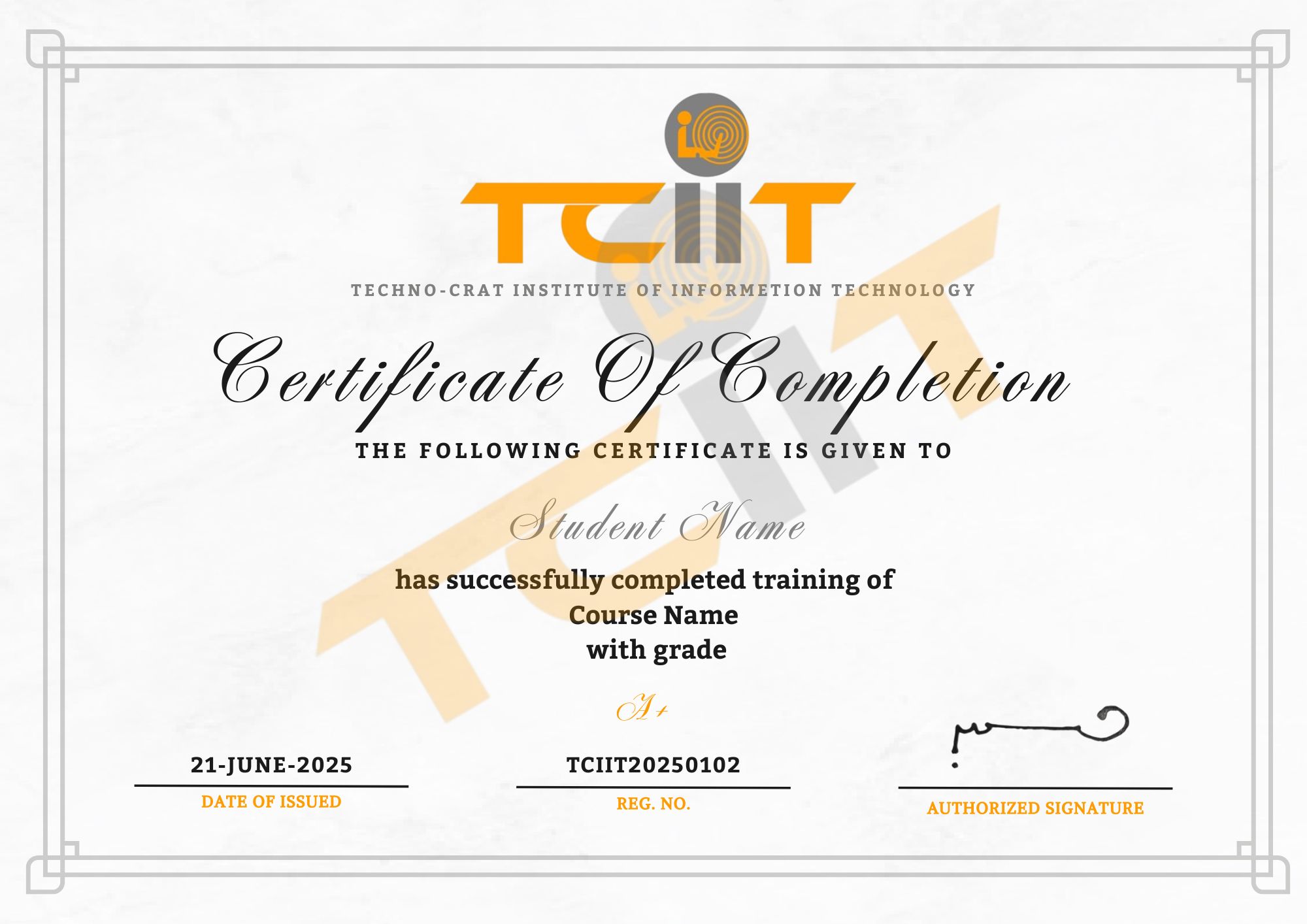
The certificate for this Machine Learning course will be delivered through our learning management system (LMS). You can download your certificate anytime and add the certificate link to your CV, resume, or LinkedIn profile to highlight your Machine Learning expertise.

thumb
whatsapp