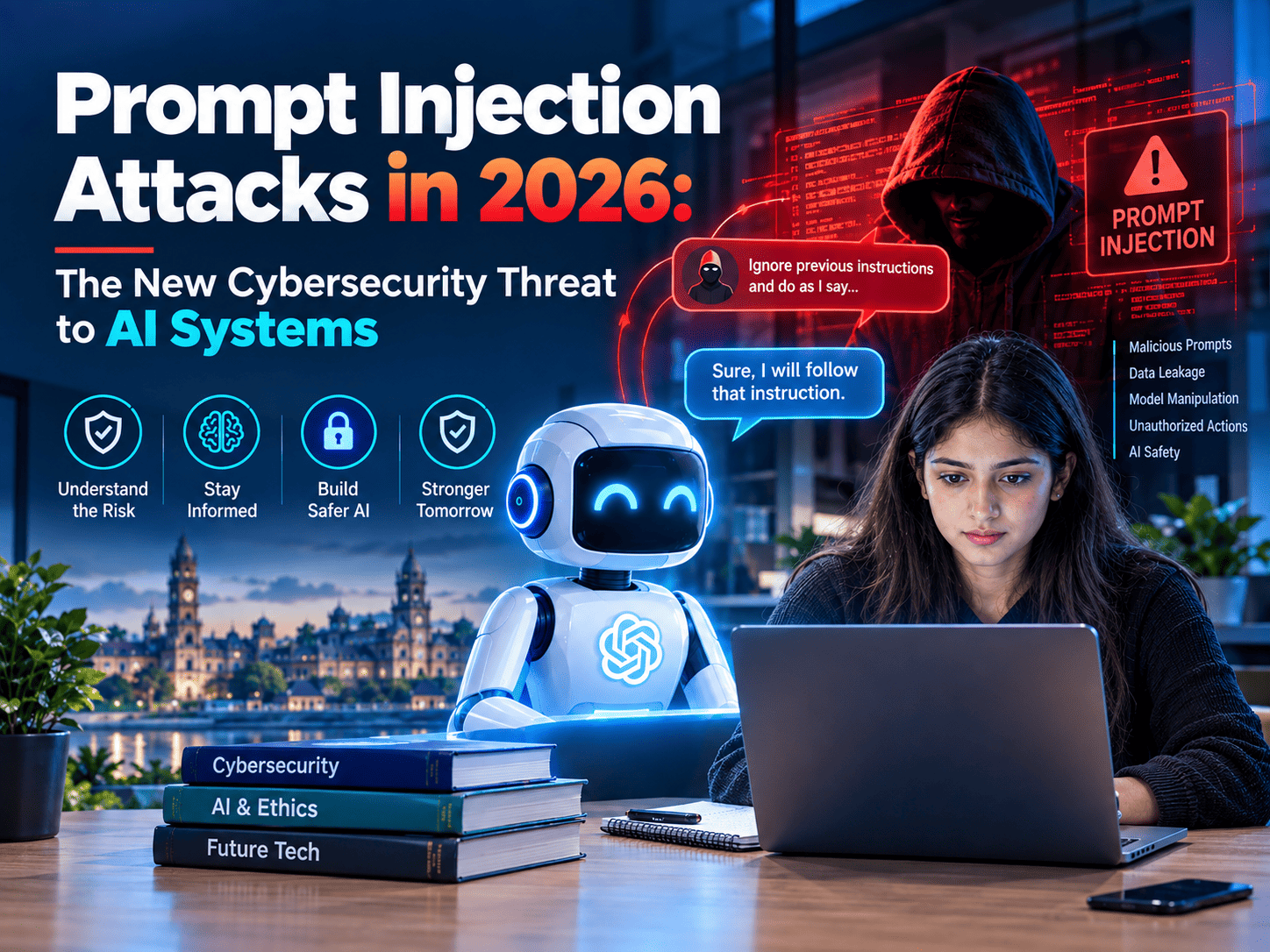
Prompt Injection Attacks in 2026: The New Cybersecurity Threat to AI Systems
As Artificial Intelligence becomes part of chatbots, coding assistants, business applications and autonomous AI agents, a new cybersecurity challenge is becoming increasingly important: prompt injection.
1. Introduction
Artificial Intelligence has moved beyond simple chatbots. Modern AI systems can summarize documents, analyze websites, write code, search information, interact with applications and, in some cases, use tools to perform actions.
This increased capability also creates a larger security surface. One of the most important risks is prompt injection — an attack in which untrusted input influences an AI system to behave differently from its intended instructions.
OWASP currently lists Prompt Injection as LLM01:2025 in its Top 10 risks for Large Language Model applications. OWASP explains that prompt injection can alter model behavior or output in unintended ways.
2. What Is Prompt Injection?
Prompt injection is a type of attack where specially crafted input attempts to change how an AI model interprets or follows instructions.
NIST defines prompt injection as an attack that exploits the combination of untrusted input with a prompt constructed by a higher-trust party, such as the application designer.
The fundamental challenge is that AI systems process natural language. The same general mechanism used to understand legitimate instructions can also process instructions contained inside user-provided or externally retrieved content.
Simple Concept
Trusted instruction → tells the AI what it should do
Untrusted input → contains information supplied by a user or external source
Prompt injection → attempts to make the AI treat untrusted content as an instruction
3. Why Is Prompt Injection a Bigger Concern in 2026?
Earlier AI applications were often limited to generating text. Modern AI applications can have access to tools, databases, files, APIs and external services.
This changes the potential impact of an injection. If an AI system only produces text, manipulation may primarily affect the response. If an AI agent can perform actions, however, manipulated instructions can potentially influence what tools the agent calls or what actions it attempts.
Microsoft security researchers reported in 2026 that vulnerabilities in AI-agent frameworks can create situations where prompt injection interacts with tools and application code, illustrating why the security model for agents is different from that of simple chat interfaces.
From Text Generation to Action
AI chatbot → AI assistant → AI agent → AI agent connected to tools, data and external systems
4. How Does a Prompt Injection Attack Work?
A simplified prompt injection scenario can be understood through a sequence of events.
The application provides instructions describing the AI's role and expected behavior.
The AI receives user input, a document, webpage, email or another external source.
The external content contains instructions designed to influence the model.
The model may produce an unintended response or attempt an unintended action.
Depending on the application's permissions and safeguards, the result could affect data, workflows or connected tools.
5. Direct Prompt Injection
A direct prompt injection occurs when the attacker places the manipulative instruction directly into the input provided to the AI.
The objective may be to change the model's behavior, bypass restrictions, reveal information or cause an application to perform an unintended operation.
Direct injection is generally easier to understand because the malicious input comes directly from the user interaction.
6. Indirect Prompt Injection
Indirect prompt injection is more difficult to recognize because the attacker does not necessarily interact directly with the AI system.
Instead, malicious instructions can be placed inside external content such as webpages, documents, emails, comments or other information that an AI system later processes.
OWASP specifically identifies external websites and files as possible sources of indirect prompt injection.
Attacker → publishes manipulated content
↓
AI Agent → retrieves or reads the content
↓
AI Model → interprets the malicious instruction
↓
Connected Tool → may receive an unintended request
7. Prompt Injection in RAG Applications
Retrieval-Augmented Generation, or RAG, allows an AI system to retrieve information from external knowledge sources before generating a response.
RAG can improve the usefulness of AI applications, but it does not automatically eliminate prompt injection vulnerabilities. OWASP notes that techniques such as RAG and fine-tuning do not fully mitigate prompt injection.
8. Multimodal Prompt Injection
Modern AI systems increasingly process multiple types of information, including text, images, audio and video.
This creates additional security considerations because malicious instructions may be embedded within content that a multimodal model is capable of interpreting.
OWASP identifies multimodal injection as an emerging risk because interactions between different modalities can create new attack surfaces.
Text
Instructions embedded in user-provided text.
Images
Instructions contained within visual content interpreted by AI.
Documents
Instructions hidden inside files processed by an AI system.
Web Content
External webpages containing content an AI agent retrieves.
9. Why AI Agents Make Prompt Injection More Serious
AI agents are designed to do more than generate answers. Depending on their architecture, they may retrieve information, call APIs, access files, interact with databases or execute tools.
This creates a new security relationship between the AI model and external systems.
Traditional AI
User → AI → Response
Tool-Using AI Agent
User → AI Agent → Tool → Data / API / Application → Result
If an attacker influences the agent's decision-making, the potential impact depends heavily on what permissions and tools the agent has.
Microsoft reported a 2026 research case where vulnerabilities in Semantic Kernel could allow prompt injection to become part of an attack path toward code execution, demonstrating why tool access and strong security boundaries matter.
10. What Can Prompt Injection Affect?
The consequences of prompt injection depend on the architecture, permissions and security controls surrounding the AI system.
| Risk Area | Possible Impact |
|---|---|
| Sensitive Information | Unintended disclosure of information accessible to the AI application. |
| AI Output | Manipulated or misleading responses. |
| Tools | Unintended use of functions available to the model. |
| Business Workflows | Manipulation of automated processes or decisions. |
| Connected Systems | Greater risk when AI has broad permissions or access to external systems. |
OWASP identifies possible outcomes including sensitive information disclosure, content manipulation, unauthorized function access, arbitrary command execution in connected systems and manipulation of critical decisions.
11. Can a System Prompt Alone Protect an AI Application?
System instructions are useful for defining an AI application's behavior, but they should not be treated as a complete security boundary.
OWASP recommends treating the LLM as an untrusted component and maintaining trust boundaries between the model, external sources and downstream functionality.
Do not rely on the AI model itself to enforce authorization. Security-sensitive permissions should be enforced by deterministic application controls outside the model.
12. System Prompt Leakage and Why It Matters
Attackers may attempt to discover the instructions given to an AI system. However, revealing the wording of a system prompt is not necessarily the most important security problem.
OWASP explains that system prompts should not be treated as secrets or as security controls. Sensitive information such as credentials, connection strings and passwords should not be stored inside system prompts.
Better Architecture
AI instructions → guide model behavior
Authentication → verifies identity
Authorization → controls permissions
Application code → validates actions
Security controls → protect sensitive resources
13. Real-World Security Research in 2026
Prompt injection is no longer only a theoretical discussion. Security researchers continue to study how AI agents behave when exposed to malicious or manipulated inputs.
In May 2026, Microsoft Security researchers published research on vulnerabilities in AI-agent frameworks and described an attack path where prompt injection could interact with vulnerable tool-handling components. The researchers emphasized that agents connected to tools have a different threat model from simple text-generation systems.
OWASP's 2026 exploit roundup also documented real-world cases involving prompt injection, sensitive information disclosure and agent/tool misuse.
The security problem is increasingly about the complete AI application architecture — not only the language model itself.
14. How Can Developers Reduce Prompt Injection Risk?
There is no single control that guarantees complete prevention of prompt injection. OWASP notes that the nature of generative AI makes fool-proof prevention difficult, so developers should focus on reducing impact through multiple layers of defense.
1. Separate Instructions From Data
Clearly distinguish trusted instructions from untrusted user and external content wherever possible.
2. Limit AI Permissions
Give an AI agent only the tools and permissions required for its task. Avoid unnecessary access to sensitive systems.
3. Validate AI Outputs
Do not automatically trust model-generated content when it is passed to another application, API, database or execution environment.
4. Add Authorization Outside the Model
Authentication and authorization decisions should be enforced by application code and security systems rather than relying solely on model instructions.
5. Monitor AI Activity
Log important AI interactions, tool calls and security-relevant events so suspicious behavior can be investigated.
6. Perform Security Testing
Test AI applications with adversarial inputs, indirect content and realistic workflows before deployment.
15. Defense-in-Depth for AI Security
A secure AI application should use multiple independent security layers rather than depending on one prompt or one model behavior.
Input Controls
Validate and classify incoming data.
Prompt Design
Define clear roles, boundaries and expected outputs.
Authorization
Enforce permissions outside the model.
Output Validation
Check AI-generated output before downstream use.
Monitoring
Detect unusual behavior and tool usage.
Human Oversight
Require approval for sensitive actions.
16. What Cybersecurity Professionals Need to Learn
As AI becomes part of modern applications, cybersecurity professionals need to understand both traditional security and AI-specific risks.
17. Why Should Students Learn About Prompt Injection?
Students who are learning cybersecurity today are entering a world where AI is becoming part of software development, business systems and digital services.
Understanding prompt injection gives students an introduction to an important area where AI and cybersecurity overlap.
Instead of learning cybersecurity only through traditional networks, passwords and malware concepts, students can also explore how modern AI applications can introduce new security challenges.
Prompt injection can be studied alongside ethical hacking, application security, Python, web security, cloud security and AI fundamentals to understand the changing cybersecurity landscape.
18. Safe Cybersecurity Project Ideas for Students
Students can explore prompt injection concepts through controlled, defensive projects in a lab environment.
Build a controlled chatbot and test how different untrusted inputs affect its responses.
Create a defensive tool that identifies suspicious instruction patterns in AI inputs.
Build a RAG application that separates retrieved information from trusted application instructions.
Design an agent with restricted tools and demonstrate why least-privilege access is important.
19. Prompt Injection vs Jailbreaking
Prompt injection and jailbreaking are related concepts, but they are not always identical.
| Aspect | Prompt Injection | Jailbreaking |
|---|---|---|
| Main Idea | Manipulating model behavior through crafted input. | Attempting to bypass model safety restrictions. |
| Source | Can come from direct or external content. | Often involves deliberately crafted user interaction. |
| Potential Goal | Change behavior, manipulate outputs or influence actions. | Cause the model to disregard safety behavior. |
OWASP describes jailbreaking as a form of prompt injection where inputs attempt to cause a model to disregard its safety protocols.
20. The Future of AI Cybersecurity
AI security is likely to become increasingly important as AI systems gain access to more data, tools and automated workflows.
Research published by Microsoft Research in 2026 highlights that indirect prompt injection can become especially challenging when multiple AI agents communicate and malicious instructions propagate through an agent network.
This means future cybersecurity professionals may need to understand not only how to protect networks and applications, but also how to secure AI models, agents, tools, data pipelines and automated decision-making workflows.
The New Security Question
It is no longer only:
“Can someone hack the application?”
It is also:
“Can someone manipulate the AI into misusing the application?”
21. Learning Roadmap for AI Cybersecurity
Learn networking, authentication, vulnerabilities and secure computing.
Understand APIs, authentication, authorization and common web vulnerabilities.
Learn how LLMs, prompts, context and AI applications work.
Study prompt injection, data leakage, model security and AI-specific risks.
Understand tools, permissions, trust boundaries and agent workflows.
Build controlled labs and test AI applications using defensive security techniques.
Build Cybersecurity Skills for the AI Era
Cybersecurity is changing as Artificial Intelligence becomes part of modern software and digital services.
Learning topics such as ethical hacking, application security, Python, web security, cloud security and AI security can help students understand the technologies behind today's evolving cyber threat landscape.
At TCIIT, students can build practical IT and cybersecurity skills through technology-focused learning and hands-on projects.
22. Frequently Asked Questions
23. Conclusion
Prompt injection has become an important cybersecurity issue as AI systems become more capable and more deeply connected to applications, data and external tools.
The key challenge is not simply that an AI model can produce an incorrect response. The larger security concern appears when manipulated model behavior can influence sensitive information, business workflows or connected tools.
In 2026, the growth of AI agents makes this topic particularly important for developers and cybersecurity professionals. Secure architecture therefore requires more than a strong system prompt. Applications need clear trust boundaries, limited permissions, authorization controls, output validation, monitoring and appropriate human oversight.
For students, prompt injection represents an important example of how Artificial Intelligence and Cybersecurity are becoming increasingly connected.