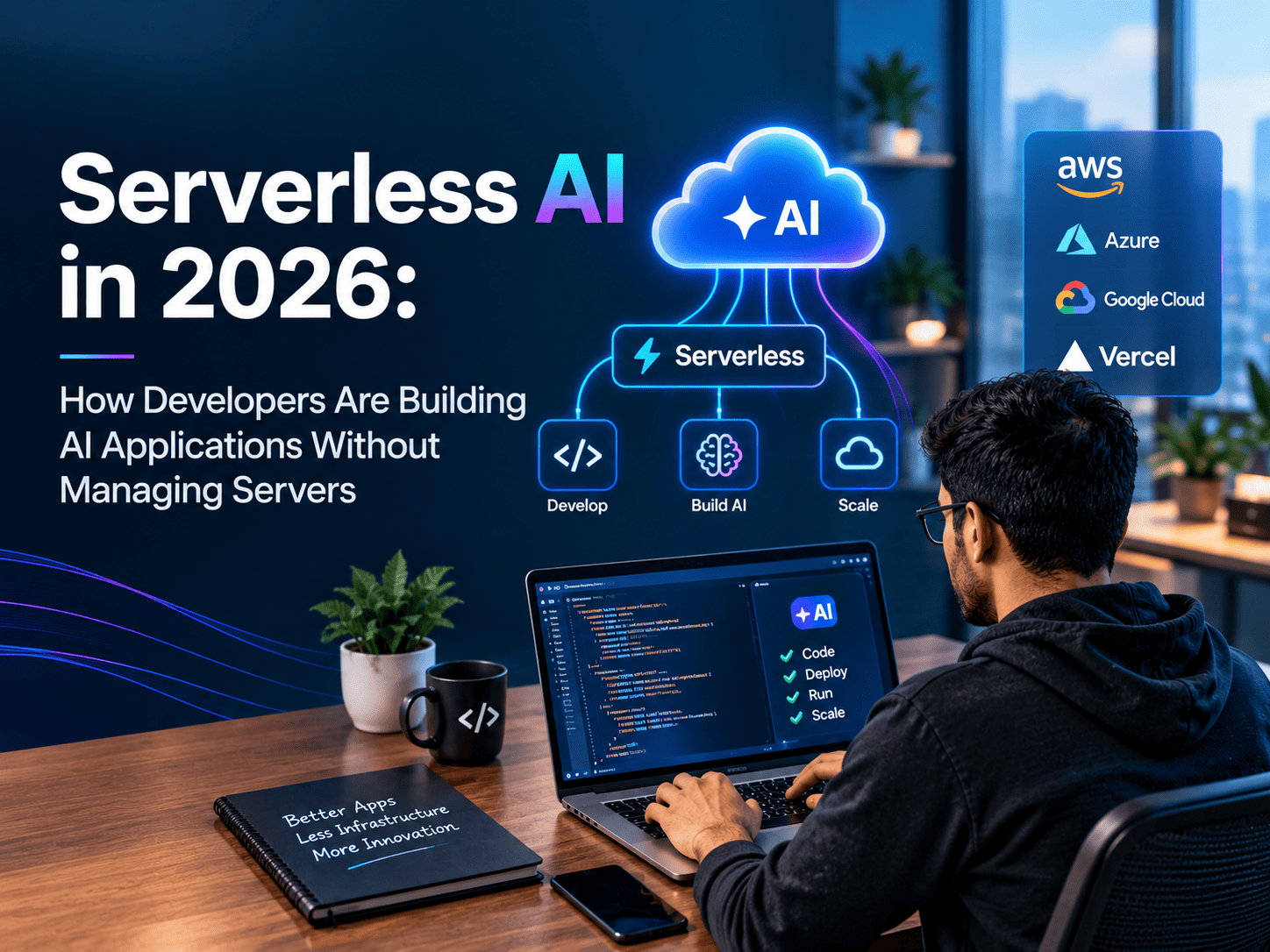
Serverless AI in 2026: How Developers Are Building AI Applications Without Managing Servers
Artificial Intelligence is becoming a core part of modern applications. At the same time, serverless computing is changing how developers build, deploy and scale software. Together, these technologies are creating a new way to build AI-powered applications without directly managing traditional server infrastructure.
1. Introduction
Building an AI application traditionally involved much more than writing application code. Developers and engineering teams often had to think about servers, computing resources, infrastructure, deployment, scaling, networking, monitoring and security.
In 2026, cloud platforms are making this process increasingly abstract. Developers can build applications where compute resources are provided on demand while managed AI services handle much of the complexity involved in model access and inference.
This approach is commonly described as Serverless AI.
Serverless does not mean that servers no longer exist. The servers are still part of the cloud infrastructure, but the cloud provider manages the underlying infrastructure so developers can focus more on application logic.
2. What Is Serverless Computing?
Serverless computing is a cloud development model where developers can build and run applications without directly managing the underlying servers.
Cloud providers handle tasks such as infrastructure provisioning, server maintenance and automatic scaling. Developers primarily focus on application code and services.
Serverless platforms are commonly used for APIs, event-driven applications, background processing, scheduled jobs and other workloads that do not require developers to maintain continuously running servers.
Traditional Server Model
Developer → Server → Operating System → Application → Database
Serverless Model
Developer → Cloud Services → Application Logic → Managed AI / Database
The main difference is that infrastructure management is moved from the development team to the cloud provider.
3. What Is Serverless AI?
Serverless AI refers to building AI-powered applications using serverless compute and managed AI services instead of directly maintaining the infrastructure required to run every component.
A developer might create a web application where a user submits a question, an event triggers a serverless function, that function calls an AI model through an API, and the generated response is returned to the user.
This type of architecture can be especially useful when application workloads are unpredictable, intermittent or event-driven.
4. How Does Serverless AI Work?
A serverless AI application usually consists of several cloud services working together rather than one large application server.
A user interacts with an application through a website, mobile app or API.
An API request or event starts the serverless workflow.
A cloud function executes the required application logic.
The function sends the required input to an AI model or managed AI service.
The model generates a response such as text, classification, summary, recommendation or structured output.
The application processes the response and sends the final result back to the user or another system.
5. Why Combine Serverless Computing With AI?
AI applications can have unpredictable workloads. A chatbot may receive hundreds of requests at one moment and very few requests at another. A document-processing system may remain idle for hours and then suddenly process thousands of files.
Serverless architecture can respond to these kinds of workloads by executing components when they are needed instead of requiring developers to maintain application servers continuously.
| Requirement | How Serverless Helps |
|---|---|
| Variable traffic | Cloud infrastructure can scale based on workload. |
| Event-driven AI | Events can trigger processing workflows. |
| Rapid development | Developers can focus on application logic instead of server maintenance. |
| Background processing | Functions can execute only when processing is required. |
6. A Typical Serverless AI Architecture
A modern serverless AI application can contain several independent services. Each component performs a specific responsibility.
Frontend → Website or mobile application
↓
API Layer → Receives requests
↓
Serverless Functions → Execute business logic
↓
AI Service → Generates predictions or responses
↓
Database / Storage → Stores application data
This modular approach allows different parts of the application to be developed, tested and scaled independently.
7. Event-Driven AI Applications
Event-driven architecture is particularly useful for serverless AI. Instead of keeping a process running continuously, an event can start the required workflow.
An event could be a user request, file upload, payment transaction, database update, sensor signal or completion of another AI operation.
Event-driven architecture can help keep components loosely coupled and can make complex AI workflows easier to organize.
8. Building AI Chatbots With Serverless Architecture
AI chatbots are one of the easiest examples of serverless AI applications.
Instead of running a dedicated application server continuously, developers can create an API endpoint that invokes serverless application logic whenever a user sends a message.
9. Serverless AI and RAG Applications
Retrieval-Augmented Generation, commonly known as RAG, allows an AI application to retrieve relevant information from an external knowledge source before generating an answer.
Serverless architecture can be used to build different parts of a RAG workflow, including document ingestion, preprocessing, embedding generation, retrieval and response generation.
Documents → Storage
↓
Processing Function
↓
Embeddings / Vector Store
↓
User Query
↓
Relevant Context → AI Model → Answer
10. Serverless AI Agents
The combination of serverless architecture and AI agents is another important development in modern application design.
An AI agent may need to interpret an event, reason about a task, retrieve information, call tools and perform an action.
Serverless components can provide individual functions or services that an agent invokes when needed.
11. Real-World Use Cases of Serverless AI
Serverless AI can support many different types of applications.
AI Chatbots
Conversational applications that respond to user questions.
Document AI
Extracting, summarizing and classifying information from documents.
Recommendation Systems
Generating personalized recommendations based on application data.
Content Processing
Automatically analyzing text, images or other uploaded content.
AI APIs
Providing AI capabilities to websites, mobile apps and business systems.
Automation
Triggering AI-powered workflows when specific events occur.
12. Benefits of Serverless AI
Reduced Infrastructure Management
Developers do not need to directly manage traditional application servers for every workload.
Automatic Scaling
Serverless platforms can automatically adjust resources according to incoming workload.
Faster Development
Developers can combine managed services and serverless functions instead of implementing every infrastructure component themselves.
Event-Driven Workflows
AI tasks can be triggered by events such as requests, uploads, database changes and scheduled operations.
13. Challenges and Limitations
Serverless AI is powerful, but it is not automatically the correct architecture for every application.
- Cold starts: Some serverless workloads can experience startup latency.
- AI inference latency: Model responses may take significant time depending on the workload and model.
- Cost management: AI API usage and serverless execution still need monitoring and optimization.
- Vendor dependency: Applications can become closely integrated with specific cloud services.
- Debugging: Distributed serverless workflows can be more complex to observe and troubleshoot.
- Security: Permissions, API access, data handling and AI outputs must be carefully controlled.
14. Security in Serverless AI Applications
Security becomes particularly important when AI applications process private information or interact with external systems.
- Authentication and authorization
- Least-privilege permissions
- Secure API access
- Encryption of sensitive data
- Prompt and input validation
- Logging and monitoring
- Human approval for sensitive actions
15. Serverless AI vs Traditional AI Infrastructure
| Area | Traditional Infrastructure | Serverless AI |
|---|---|---|
| Infrastructure | Developers manage more infrastructure. | Cloud provider manages underlying infrastructure. |
| Scaling | Often requires configuration and planning. | Can scale automatically according to workload. |
| Development | More infrastructure responsibility. | More focus on application logic and services. |
| AI Integration | May require infrastructure for model serving. | Can use managed AI APIs and serverless functions. |
16. Technologies Developers Can Explore
Developers interested in Serverless AI can explore different cloud ecosystems and managed services.
Lambda, API Gateway, S3, EventBridge, Step Functions and managed AI services.
Cloud Run, Cloud Functions and other managed cloud and AI services.
Azure Functions and managed AI services for cloud applications.
17. What Skills Should Developers Learn?
Serverless AI does not eliminate the need for programming knowledge. In fact, developers need a strong understanding of software development concepts to design reliable AI applications.
18. Why Should Students Learn Serverless AI?
Students learning software development today are entering a technology environment where cloud platforms and AI are increasingly connected.
Learning serverless AI can help students understand how modern applications are designed beyond traditional local development.
Instead of building only simple desktop or local applications, students can learn how to create cloud-connected applications that use APIs, databases, AI models and event-driven workflows.
19. Serverless AI Project Ideas for Students
Students can learn the concepts by building small practical projects.
Upload a PDF and generate an AI-powered summary using a serverless processing workflow.
Build a chatbot where API requests trigger serverless functions that communicate with an AI model.
Upload a resume and generate structured feedback or skill extraction using AI.
Create a knowledge-based assistant for an institute, business or student project.
Build an API that summarizes, classifies or transforms submitted text using managed AI services.
20. Learning Roadmap for Serverless AI
Start with Python or JavaScript and understand programming fundamentals.
Understand HTTP, REST APIs, frontend applications and backend logic.
Understand cloud computing, storage, databases, functions and permissions.
Learn how applications communicate with AI models through APIs.
Combine cloud functions, APIs, databases and AI into practical projects.
Understand logging, permissions, error handling and responsible AI usage.
21. How Serverless AI Is Changing the Developer's Role
Serverless does not remove the need for developers. Instead, it changes where developers spend their time.
Developers increasingly focus on application architecture, business logic, APIs, security, AI integration, data flow, testing and user experience rather than manually maintaining every infrastructure component.
Developer Focus
From “How do I maintain this server?” toward “How should I design this intelligent application?”
22. The Future of Serverless AI
Serverless AI is likely to continue evolving as cloud platforms provide more managed AI capabilities, better event-driven workflows, improved observability and stronger tools for AI application development.
AI agents, RAG systems, automated workflows and intelligent APIs can all benefit from architectures that execute components on demand.
The broader direction is toward applications where developers compose managed services instead of manually operating every layer of the infrastructure.
23. Frequently Asked Questions
Learn the Skills Behind Modern AI Applications
Serverless AI brings together programming, cloud computing, APIs, databases and Artificial Intelligence.
For students in Vadodara, building a strong foundation in programming, Python, AI, web development and practical project development can make it easier to understand and explore modern cloud-based technologies.
At TCIIT, students can explore programming, Python, AI, web development and practical technology skills through project-oriented learning.
25. Conclusion
Serverless AI is changing the way developers think about building intelligent applications.
Instead of spending most of their time managing traditional servers, developers can combine serverless functions, APIs, databases, event-driven workflows and managed AI services to create modern applications.
The technology does not remove the need for programming or software engineering knowledge. Instead, it increases the importance of architecture, security, testing, cloud concepts and responsible AI development.
For students learning technology in 2026, Serverless AI represents an interesting intersection between AI, cloud computing, programming and modern application development.