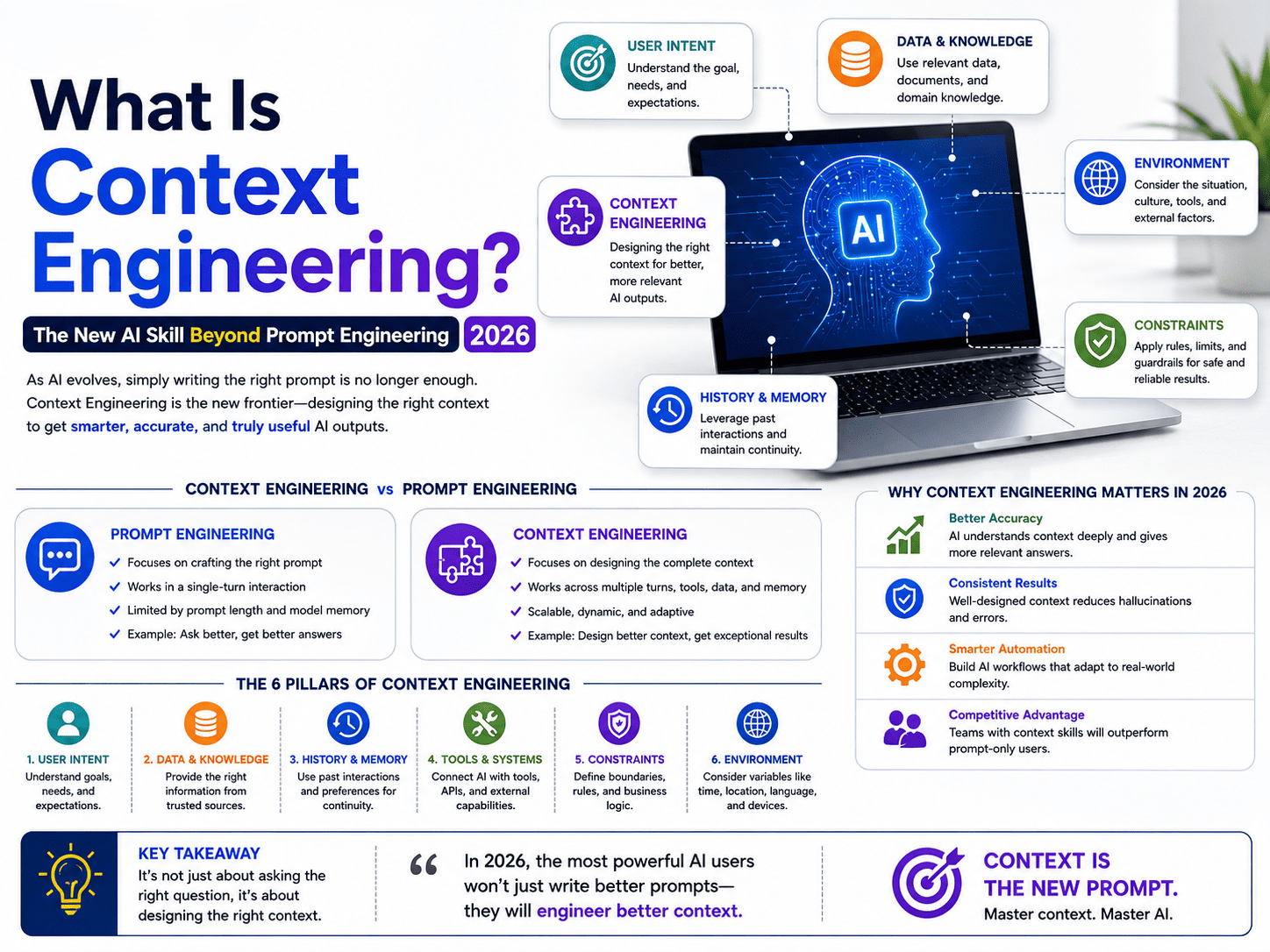
What Is Context Engineering? The New AI Skill Beyond Prompt Engineering in 2026
Context Engineering is becoming one of the most important concepts in modern Artificial Intelligence development. While Prompt Engineering focuses mainly on writing effective instructions for AI models, Context Engineering takes a much broader approach: it focuses on giving an AI system the right information, tools, instructions, memory, examples, and environment at the right time.
As AI applications become more advanced in 2026, developers are moving beyond simple chatbot prompts. Modern AI systems need to work with company documents, databases, APIs, user preferences, previous conversations, tools, real-time information, and application rules. Managing all of this information effectively is where Context Engineering becomes important.
Context Engineering is the practice of designing and managing the information an AI model receives so that it has the right context to produce accurate, relevant, reliable, and useful results. It includes prompts, retrieved data, memory, tools, system instructions, examples, and the overall flow of information provided to an AI model.
Table of Contents
- What Is Context Engineering?
- Context Engineering vs Prompt Engineering
- Why Context Engineering Is Important in 2026
- What Does Context Include?
- How Context Engineering Works
- Context Engineering and AI Agents
- Role of RAG in Context Engineering
- Context Engineering and AI Memory
- Context Engineering vs Prompt Engineering vs RAG
- Real-World Examples
- Benefits of Context Engineering
- Challenges and Limitations
- Skills Required to Learn Context Engineering
- Career Opportunities
- Future of Context Engineering
- Frequently Asked Questions
What Is Context Engineering?
Context Engineering is an approach to AI development where developers carefully design the complete context available to an AI model before and during a task.
A simple prompt might say:
This gives the model an instruction, but very little additional information. A context-engineered request could provide the AI with the target audience, previous articles, company information, brand guidelines, keywords, research documents, examples, current data, writing rules, and tools required to complete the task.
The goal is not simply to create a longer prompt. The goal is to create a better information environment for the AI system.
Prompt Engineering asks: "What should I tell the AI?"
Context Engineering asks: "What information does the AI need to perform this task correctly?"
Why Is Context Engineering Becoming Important in 2026?
The first wave of generative AI focused heavily on chatbots and prompt engineering. Users learned how to write better instructions to obtain better answers. However, modern AI applications are becoming much more complex.
AI systems are increasingly expected to perform multi-step tasks rather than simply generate text. An AI agent may need to understand a user's request, search a knowledge base, retrieve relevant documents, call an API, remember previous information, evaluate the result, and then perform another action.
That means the quality of the final answer depends on much more than the original prompt.
| Traditional AI | Modern AI Systems |
|---|---|
| Single prompt | Dynamic context |
| One response | Multi-step reasoning and actions |
| Limited information | Documents, memory, tools and data |
| Static instructions | Context assembled dynamically |
Context Engineering vs Prompt Engineering
The terms are closely related, but they are not identical. Prompt Engineering is an important part of Context Engineering, but Context Engineering covers a much larger system.
| Prompt Engineering | Context Engineering |
|---|---|
| Focuses on instructions | Focuses on the complete information environment |
| Usually prompt-centric | System-centric |
| Instructions and examples | Instructions + data + memory + tools + state |
| Often static | Can be dynamic |
| Useful for individual interactions | Useful for complete AI applications and agents |
In simple terms, Prompt Engineering is about the message; Context Engineering is about the environment surrounding the message.
What Can Be Included in AI Context?
Context can contain many different types of information. The exact combination depends on the application and the task.
- System instructions: Rules that define how the AI should behave.
- User input: The current request or question.
- Conversation history: Relevant previous interactions.
- Retrieved documents: Information selected from a knowledge base.
- Examples: Previous examples showing the desired output.
- Memory: Useful information retained from previous interactions.
- Tool information: Available functions and APIs the AI can use.
- Application state: Current information about what is happening inside the application.
- Real-time data: Fresh information retrieved from external systems.
- Output requirements: Formatting, structure, validation, or business rules.
How Does Context Engineering Work?
A context-engineered AI application generally follows a process in which relevant information is collected, filtered, organized, and provided to the model.
Step 1 → Understand the Task
The system identifies what the user wants to accomplish.
Step 2 → Identify Required Context
The application determines which information is necessary.
Step 3 → Retrieve Relevant Information
Documents, database records, APIs, memory, or other sources may be accessed.
Step 4 → Filter and Organize
Irrelevant information is removed and useful information is structured.
Step 5 → Build the Context
The application combines instructions, data, examples, and other relevant information.
Step 6 → Send Context to the Model
The AI model receives the assembled context and performs the requested task.
Step 7 → Evaluate the Result
The application may validate the response or perform another AI/tool step.
Context Engineering and AI Agents
One of the biggest reasons Context Engineering has become important is the growth of AI agents.
An AI agent is designed to perform tasks using reasoning, tools, memory, and multiple steps. For example, a customer-support agent may need to understand a question, identify the customer, retrieve their order history, check company policies, access shipping information, and provide an appropriate response.
Giving the agent all available information would be inefficient. The system needs to decide which information is relevant at each stage.
A customer asks: "Where is my order?"
The AI does not need the company's entire database. It may need:
- Customer ID
- Order number
- Latest shipping status
- Delivery information
- Relevant support policy
The Role of RAG in Context Engineering
Retrieval-Augmented Generation (RAG) is closely connected to Context Engineering. RAG allows an AI application to retrieve relevant information from external knowledge sources and provide that information to the model before generating a response.
For example, imagine a company has thousands of internal documents. Instead of placing every document into the model's context, a retrieval system can search the company's knowledge base and select only the documents relevant to the user's question.
| RAG Component | Role |
|---|---|
| User Query | Defines what information is needed |
| Retriever | Finds relevant information |
| Vector Database | Stores searchable representations |
| Context Builder | Organizes retrieved information |
| LLM | Generates the response |
Context Engineering and AI Memory
Memory is another important component of advanced AI systems. A chatbot that remembers useful information from previous interactions can provide a more personalized experience.
However, storing everything is not necessarily a good strategy. Context Engineering involves deciding what should be remembered, when it should be retrieved, and when it should be ignored.
- Short-term conversation context
- Long-term user preferences
- Task-specific memory
- Previous decisions
- Relevant historical information
- Application state
Good memory management prevents an AI system from becoming overloaded with irrelevant historical information.
Context Engineering vs RAG
RAG and Context Engineering are not competing technologies. RAG can be one component inside a broader Context Engineering architecture.
| Technology | Main Purpose |
|---|---|
| Prompt Engineering | Design effective instructions |
| RAG | Retrieve external information |
| Memory | Maintain useful information across interactions |
| Context Engineering | Coordinate the information supplied to the AI system |
Real-World Examples of Context Engineering
1. AI Customer Support
A customer-support AI can combine the user's question, account information, previous conversation, product documentation, refund policies, and current order status to generate a useful response.
2. AI Coding Assistant
A coding assistant can use the user's request together with the current project structure, relevant source files, coding standards, dependencies, error logs, and previous changes.
3. AI Sales Assistant
A sales agent can combine customer information, CRM records, previous communications, product details, pricing rules, and company policies.
4. AI Research Assistant
A research assistant can retrieve relevant documents, summarize previous findings, identify gaps, and use external tools to gather additional information.
5. AI Education Assistant
An educational AI can use a student's course level, previous questions, learning progress, syllabus, examples, and assessment results to personalize explanations.
Benefits of Context Engineering
- More accurate responses because the AI receives relevant information.
- Better personalization through memory and user-specific context.
- Reduced hallucinations when reliable external information is supplied.
- Better AI agents because agents can access the right tools and data.
- Improved consistency through clear system instructions and business rules.
- Better scalability because applications can retrieve information dynamically.
- More useful automation because AI systems can operate with application data and tools.
Challenges of Context Engineering
Context Engineering is powerful, but it introduces new technical challenges. More context does not automatically mean better AI performance.
- Context overload: Too much information can make it harder for the model to focus on relevant details.
- Context selection: The system must determine what information is actually useful.
- Token limitations: Models have finite context windows and processing costs.
- Data quality: Incorrect retrieved information can lead to incorrect answers.
- Latency: Multiple retrieval and tool calls can increase response time.
- Security: Sensitive information must be handled carefully.
- Evaluation: Developers need ways to measure whether the supplied context actually improves results.
The objective is not to provide the AI with maximum context. The objective is to provide the AI with the right context.
What Skills Are Needed for Context Engineering?
Context Engineering is not a single software tool or programming language. It combines multiple areas of AI and software development.
| Skill | Why It Matters |
|---|---|
| Prompt Engineering | Creates effective instructions |
| LLM Fundamentals | Understanding model behavior |
| RAG | Retrieving relevant knowledge |
| Vector Databases | Semantic information retrieval |
| APIs | Connecting AI to external systems |
| Programming | Building AI applications |
| AI Agents | Managing multi-step AI workflows |
Is Context Engineering a New Career Skill?
Context Engineering is emerging as a valuable skill within the broader AI engineering ecosystem. It is better understood as a set of practices rather than a completely separate job title in every organization.
Companies building AI-powered products need developers who understand how to connect models with data, tools, memory, APIs, and business logic. These capabilities are becoming especially relevant for AI Engineers, LLM Engineers, AI Application Developers, AI Agent Developers, and Generative AI Developers.
Prompt Engineering Is Not Dead
The rise of Context Engineering does not mean that Prompt Engineering has become useless. Prompt design remains an important part of building reliable AI systems.
The difference is that developers are beginning to recognize that a great prompt cannot compensate for missing or poor context.
Prompt Engineering → RAG → AI Applications → AI Agents → Context Engineering
The future is not necessarily about choosing between Prompt Engineering and Context Engineering. Instead, modern AI developers will use prompt design as one part of a larger system for managing context.
Future of Context Engineering in 2026 and Beyond
As AI systems become more autonomous, the importance of context management is likely to increase. Future AI applications will need to continuously determine what information matters, which tools should be used, what memories should be retrieved, and what information should be excluded.
This is particularly important for AI agents. An agent operating over a long task may encounter hundreds of pieces of information. Providing everything to the model is inefficient. A context-aware architecture can dynamically select the information required for each step.
This makes Context Engineering an important concept for developers who want to build reliable, scalable, and production-ready AI applications.
Frequently Asked Questions About Context Engineering
What is Context Engineering in AI?
Context Engineering is the practice of designing and managing the information supplied to an AI model, including instructions, retrieved data, memory, tools, examples, and application state.
Is Context Engineering the same as Prompt Engineering?
No. Prompt Engineering focuses primarily on designing instructions, while Context Engineering manages the broader information environment surrounding an AI task.
Why is Context Engineering important in 2026?
Modern AI applications increasingly use RAG, memory, APIs, tools, and AI agents. These systems require careful management of information rather than relying on a single prompt.
Does Context Engineering replace Prompt Engineering?
No. Prompt Engineering remains an important component of Context Engineering.
Is RAG part of Context Engineering?
RAG can be an important component of a Context Engineering system because it retrieves relevant external information for the AI model.
What is the most important principle of Context Engineering?
The goal is to provide the AI with the right information at the right time rather than simply providing as much information as possible.
Is Context Engineering useful for AI agents?
Yes. AI agents often need dynamic access to tools, memory, application state, and external information, making context management especially important.
What should I learn to become a Context Engineer?
Useful areas include LLM fundamentals, Prompt Engineering, RAG, vector databases, APIs, programming, AI agents, data retrieval, and AI application architecture.
Final Conclusion
Context Engineering is one of the important emerging concepts in AI development in 2026. The evolution from simple prompts to sophisticated AI agents has changed what developers need to think about when building AI applications.
Instead of asking only, "How can I write a better prompt?", developers increasingly need to ask, "What does the AI need to know, what tools does it need, what information should it remember, and what context should it receive at this moment?"
That shift is at the heart of Context Engineering.
For students and developers entering the Generative AI field, learning Prompt Engineering is still valuable. But combining it with RAG, vector databases, APIs, AI agents, memory, tool calling, and context management provides a much stronger foundation for building real-world AI applications.
The Future of AI Is Not Just Better Prompts
It is about giving AI the right context at the right time.